
Athens Address Record Sources
A backward address trail uses sources from different eras. The Athens County Recorder’s office says its real-property records and alphabetical indexes run from 1790 to the present, but it does not give a separate starting year for the web index. AVA is the first online route, and the Recorder counter is the fallback for earlier or hard-to-find instruments. The local directories are real, dated snapshots rather than a continuous annual run. A source should be cited for what it actually shows, whether that is title, a listed address, a household snapshot, a building, or a project file.
| Trail source | Real local years | Where held | What it adds |
|---|---|---|---|
| Athens Recorder office index and records | 1790-present | Athens Recorder office | Recorded-document and title-chain evidence. |
| Athens AVA web index | Web start not stated | Athens Recorder AVA | Party, date, document, address, and legal searches. |
| Athens digitized city directory | July 1927 | Ohio University Digital Collections | Listed address, occupation, business, vicinity material. |
| Athens digitized city directory | 1932 | Ohio University Digital Collections | A second dated local listing. |
| Athens federal census context | Through 1950 released | ACPL research resources | Household, age, relationship, and enumeration context. |
| Athens Sanborn maps | 1885-1923, with 1923-1948 extent noted | Ohio Web Library | Building and street context, not inhabitants. |
Begin with the Recorder when the question is ownership. Begin with one of the two dated directories when the question is a listed address near 1927 or 1932. Use a Sanborn map to test physical continuity, and use census material for a household context that a property instrument does not provide.
Athens Parcel Records First
Past residents research is more reliable when it starts with today’s parcel key, exact situs address, and legal description rather than an assumed street string. The Auditor’s combined query accepts a parcel, owner, house number, or street name. Save the details displayed on the live parcel record, then use the parcel and legal description in the Recorder index. If a transfer uses a different street number but the same legal description or parcel, the legal clue is the stronger continuity key.
Legal description means the lot, block, subdivision, tract, parcel, or other land language used to identify property in an instrument. It is not merely a postal address. Athens County Auditor GIS provides historic tax plats, surveys, and subdivision resources that can help bridge an old map or directory line to that description. The mapping is maintained for tax purposes and shows approximate boundaries, so a deed or survey remains the source for legal boundary language.
Note: Retain the parcel number, full legal description, and each historic spelling together, because a modern address alone may not match an older record.
Athens Deed Records Backward
A chain of title is the sequence of recorded transfers for the same land. In plain terms, a grantor transfers an interest and a grantee receives it. Those roles can change at the next transaction. The Athens County Recorder AVA supports People, date, document, Address, Parcel, Subdivision, Municipality, and Tract searches. Its address fields include House No, Street, City, and Zipcode. When address words fail, move to parcel or legal-description terms.
- Use the Athens County Auditor query to identify the current parcel, situs address, legal description, and displayed owner.
- Find the most relevant AVA instrument by party, address, parcel, date, or document number. Save the document number, document type, recorded date, book/page, party roles, and legal information.
- Read the grantor as the person or party conveying in that transaction. Search that earlier party as a grantee, or reuse the legal, parcel, book/page, and document clues to locate the acquisition record.
- Repeat each documented step backward. A title chain tracks recorded interests, so do not convert it into a list of all past residents.
- When AVA does not return an older item, take the documented chain to the Recorder’s alphabetical indexes or counter. Staff assist but do not perform the search for a visitor.
- Grantor
- The party conveying an interest in a recorded instrument.
- Grantee
- The party receiving that recorded interest.
- Chain of title
- The linked sequence of recorded property transfers for the same legal parcel.
- Legal description
- The land-identifying text that can remain useful when street labels differ by era.
- Criss-cross directory
- A directory arranged by address. No verified Athens reverse-directory year run was published in the research.
- Enumeration district
- The census area used to organize a household count on its enumeration date.
The Recorder says AVA documents can be viewed and printed at no cost, but a record-specific access message controls image availability. Ordinary copies from the Recorder are $2 per page, with $1 added for certification. Those costs apply to the custodian’s copy route, not to an assumption about every online image.
Athens AVA Record Fields
A Recorder result is easier to reuse when its identifying fields travel with the note. AVA’s result and detail schema can include document number, document type, recorded date, Party1, Party2, legal information, book/page, reference number, address or parcel data, related documents, and party roles. Document type tells what kind of instrument was recorded. Book and page or document number give the Recorder a concrete starting point when an online query needs a counter check.
Athens County Probate and Juvenile Court is a separate custodian route once an estate or other court lead has been documented.
Once a probate-related case number is known from a documented lead, the court is a route for its files, not part of the Recorder title index.
Athens Address Records Through Maps
Athens has a locally documented map stack for testing whether a building or street context existed in a particular period. Ohio University’s Sanborn research identifies public-domain Athens editions for 1885, 1890, 1895, 1900, 1907, 1914, and 1923. The Ohio Web Library viewer also identifies 1923 to April 1948 mapping. A building that appears on one sheet and not an earlier sheet can bracket physical presence. It does not identify a past resident.
Search maps by address, intersection, addition, or subdivision, then compare the sheet with an historic tax plat and the legal description. Athens began as a town plat in 1799, and the City’s limits and additions have changed over time. No official citywide renumbering year or street-renaming master list was verified. When a historical line and modern address differ, test the old street spelling, map year, landmarks, plat, and parcel rather than forcing the old entry into a current ZIP label.
Ohio Vital Statistics is one official route for a verified death or birth record inquiry after a documented family-history lead.
Vital records have their own signed-application and access rules, so they should confirm a specific event rather than be used to fill an unproven address gap.
Athens Directory Years Compared
The two verified digital volumes are valuable precisely because their dates are known. Ohio University hosts the July 1927 Athens city and vicinity directory, a 106-page volume from the Southeast Ohio History Center repository, and a 1932 Athens city directory, a 50-page volume from the same repository. The 1927 volume includes city, vicinity, rural-delivery, personal, business, institutional, and classified material. Search its OCR, then inspect the scanned image before recording the line.
For a person listing, preserve the spelling, initials, spouse notation, occupation or role, telephone notation if present, and printed address. Some entries are business-only or include children’s names and ages. A line is still a dated directory listing, not title proof or a full population count. The two editions make good anchor years, but they do not prove uninterrupted directory publication between them.
For details on the volumes, shelves, and their collection records, use the Athens city directory page. The backward trail uses those dates alongside parcel and deed evidence instead of treating a directory as an ownership record.
Athens Census Record Pairing
A directory and census describe a household differently. The most recent released federal census is 1950 under the 72-year release rule. A directory may list a working adult, an occupation, and a street address close to its publication date. A census can add household relationships, ages, birthplaces, and migration or tenure context for its enumeration date. Neither source can be pushed forward to prove a current address.
- Choose the dated deed or directory line closest to the period being researched.
- Copy the exact address, spelling, and date from the original image or recorded instrument.
- Compare that evidence with the nearest released census household and its enumeration context.
- Use a Sanborn sheet or historic plat to test the location, then retain any mismatch rather than silently resolving it.
Athens County Public Libraries Local History and Genealogy resources at the Nelsonville branch, and the Southeast Ohio History Center, are the physical fallback for local directories, obituaries, yearbooks, telephone books, surname files, estate packets, and county-court microfilm. Ask for a named year, address, surname, or record type. Neither source was verified as offering a formal house-history service.
Athens Probate Record Endpoints
When a documented deed, directory, obituary, or death lead suggests an estate, Athens County Probate Court can supply the next custodian route. Probate handles estate settlement, guardianships, and marriage licenses. Its CaseLook information warns that web information can lag court activity by at least 24 hours or longer, so a request or counter inspection is the route for verified information. Court and probate records have jurisdiction and access limits of their own.
For an Athens death lead within the historical series, the Ohio History Connection death index is a research route for indexed Ohio Department of Health certificates from 1913-1944 and 1954-1970. A historic archive copy is not a certified certificate. For a current certified birth or death record, the Athens City-County Health Department uses a signed application and a $22 per-copy fee; its local application is the documented route.
The Probate Court marriage-application instructions illustrate that marriage records follow the court’s process, not the Recorder’s deed search.
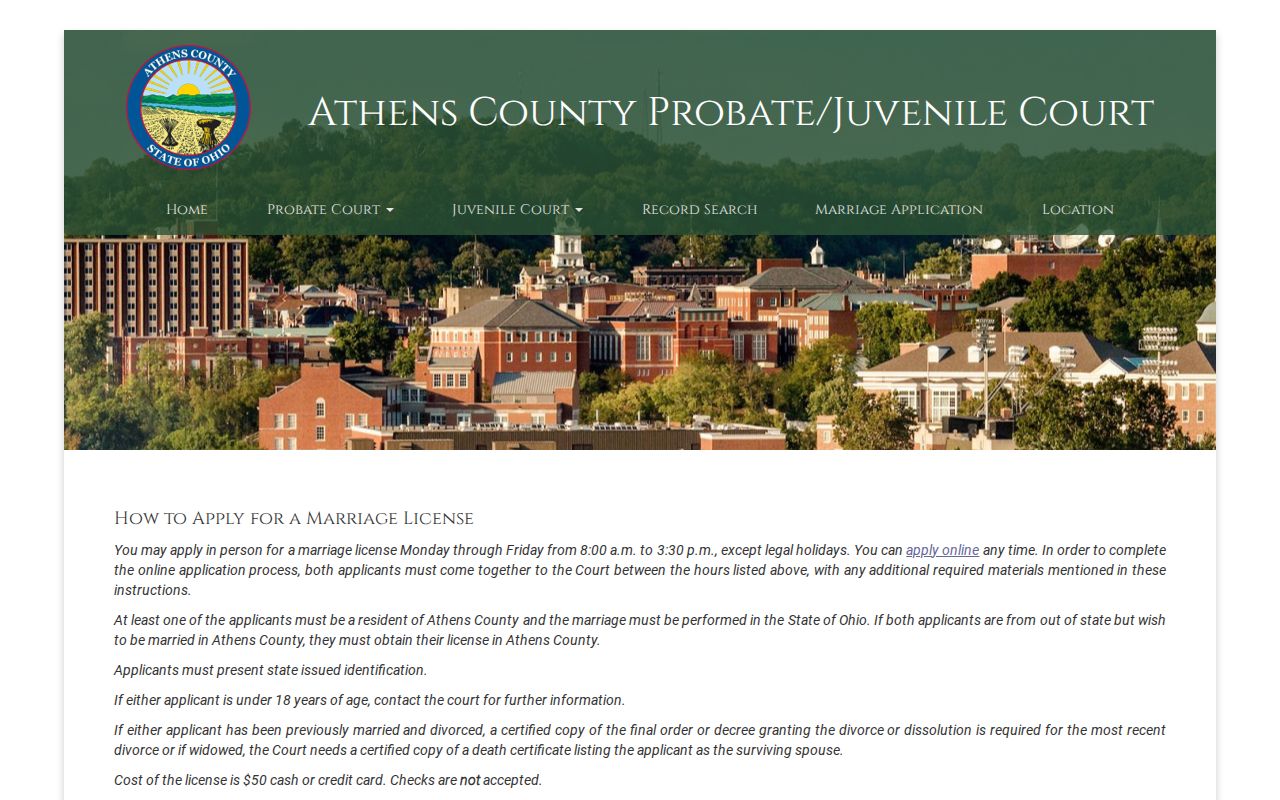
A marriage or probate record can add a dated relationship or estate context, but it should not be presented as proof that a party lived at a particular address.
Athens Previous Residents Limits
Previous residents research works best as house history or family history. The deed chain follows recorded ownership. A directory may show a listed adult near a publication date. Census material may show a household on its enumeration date. A Sanborn map describes a building. None of those sources establishes all people who lived at an address across every year, and no single source should be relabeled to make that claim.
Lawful use. Use Athens historical address records for personal, lawful family and property research. Do not use an old address, name, or court record to track, harass, intimidate, or harm a living person.
Correct a modern record with the office that maintains it. A privacy request, a property-record correction, and a request for an historical copy are separate processes. Keep the custodian, record type, and legal basis clear when asking for help.
Note: A finished trail should distinguish recorded ownership, dated listing, household context, and physical map evidence instead of merging them into one claim.